Friday, January 16, 2015

Language Adventures: Part 1

As I started thinking about writing a post about learning Hebrew/living in a country in which I speak little of the dominant language, I came across a nearly completed post that I wrote while in Spain but somehow forgot about and never finished.  It seems like a great pre-cursor to a post about learning Hebrew, so I’m posting it now.  So while you’ll have to wait a little while longer for my post about learning and living in Hebrew, here’s a flashback to my summer travels:

I learned a handful of random words in Dutch during my brief stay in the Netherlands, but it turns out that “ladies” and “gentleman” were not included in my lessons.  At the castle we visited during our Oosterbeek walk I went to use the restroom and I encountered a confused child around 4 years old looking back and forth at the doors.  He was too young to read and the typical man and woman figures were missing from the entrances. He saw me, an adult who logically should know the answer, and I assume asked me which way he should go.  I shrugged both because I was almost as lost without the figures and because I couldn’t actually understand a word he said.  He shrugged back and our mutual confusion continued to grow for a few moments until I finally used my limited knowledge of other languages to correctly deduce which way to send us both.  I still find this funny because it highlights the most basic challenges of being immersed in a completely foreign language (similar to being a small illiterate child in a literate world) and because that four year old’s face so beautifully mirrored my own feelings of momentary bewilderment.

During the month I spent in Germany, I learned a handful of German words and phrases, mostly focused on food vocabulary due to my many dietary restrictions.  As a result, I could usually tell vendors at the open air market what I’d like to buy in German.  However, if I bought more than one item I usually couldn’t understand the amount they asked for payment without looking at it written down or added up on the scale.  Once on a bus in Wismar, I shocked myself by handing the correct amount to the driver after he told me the cost of a ticket.  There are plenty of Germans who speak English, but it also turns out there are also plenty who don’t.  I broke out into a nervous sweat trying to buy a SIM card, as I couldn’t understand the terms and conditions nor the differences between my options.  And no one at MediaMarkt spoke enough English to adequately explain them. On a bus in Werder I got so flustered when I couldn’t correctly tell the driver where I was going that I almost gave up and got off the bus so I could look it up on my phone while waiting for the next one. In the local shop and garden I discovered on the walk from Werder to Petzow I tried to ask the shopkeeper if the Sanddorn berries I was buying were grown on the property, just to make small talk.  She didn’t speak English, and I couldn’t find the correct words for the German translation, but because I tried so hard to find a translation, she then thought it must be a very important question, so we couldn’t seem to just let it drop. Fortunately, in most cases there were nice people to step in and help. A woman on the bus in Werder helped me figure out the stop I needed to tell the driver and an English-speaking local walked into the Sanddorn shop and translated the question and response.  And I will be forever grateful to the woman in MediaMarkt who approached me and I think said something along the lines of “you look like you really need some help” in German.  And despite her limited English she smiled, laughed, and did her very best to help me and so I left the store with a working SIM card in my phone. This was after a week-long phone unlocking/SIM card confusion saga, so her extra efforts to help me really made my day.  So, in the end, all interactions actually ended well and I learned to just ignore the many signs and overhead conversations that I couldn’t understand.  Plus, there were plenty of days in which language wasn’t an issue at all.

Still, after over a month of these little confusions, how good it felt to understand and be understood again.  I flew Iberia airlines from Zurich to Spain and in the Zurich airport, I offered to communicate in Spanish at check-in as the woman working the counter said her English wasn’t great. By the time I reached the Madrid airport, I was on cloud nine. I bought my SIM card in a store in the airport, easy as could be, and I understood all the conditions and my options for adding additional credit if I needed.   I just relished in speaking Spanish.  In Germany, one of Nikki’s uncles visited.  He spoke Spanish better than English, having lived in Chile for a few years in his twenties, so we communicated in Spanish.  And he talked about dreaming of Chile in Spanish and the emotional attachment one forms to a language after living immersed in it.  How true! My love of Spanish has been shaped by the wonderful experiences I’ve had living in Spain and working in the U.S. with Spanish speakers.  And sometimes just speaking Spanish makes me happy.  And oh how I love making small talk, which Spaniards are equally open to! 

You miss the little things when you don’t understand the conversations around you.  At the weekly market in Segovia, as I waited to buy vegetables from a vendor, a few older gentlemen were bantering with the woman selling produce.  They apparently didn’t realize that she was still helping a woman obscured by the side of the truck and that there were a couple other people standing around waiting and started to give her a hard time about coming over to sell them tomatoes.  She told them something along the lines of “Ok, I’m running to serve you immediately” as she stayed where she was and continued to help the other customer.  I found this sarcasm rather entertaining, but would have missed it entirely if I didn’t speak Spanish.

Even in Spanish, during in-depth conversations on many specialized topics, I still struggle to express myself fully.  And after arriving in Malaga, I was quickly reminded of how much harder the Malagueño accent is for me to understand than that of the Madrileños.  Even so, I still smile when I hear the Malagueño accent, as it brings a certain nostalgia for my Spanish “home.”  And when in Malaga, I quickly reverted to dropping the “s” in “gracias” and the “ta” in “hasta luego.” As I traveled around different regions in Spain, my proficiency was enough that I quickly learned to adjust for regional accents and terms, referring to the main food market as the Mercado Central in southern cities and the Plaza de Abastos when in the north. For a month I was in language heaven.  Then I landed in Israel and it started all over again – and this time it involves a different alphabet!


Wednesday, January 7, 2015

In Pursuit of Injera: Part 1

Hi All!  We are in the midst of the first (and maybe only) big winter storm in Israel and from the way the country's been preparing, you'd think the world might be coming to an end, especially in Jerusalem where it is going to (gasp!) snow.  The wind/rain/hail/lightening has been pretty incredible though.  I asked in Ulpan (Hebrew class) today if there is a Hebrew equivalent to the phrase "It's raining cats and dogs."  Apparently the phrase invokes the term mah-bool, which is used to describe the floods that wiped out the whole earth except for Noah and his ark full of creatures.  So, even winter storms are biblical in the holy land!

This week I had the opportunity to write a post for the Yahel blog.  Yahel is the organization that runs the year-long program in which I'm participating. I wrote about my pursuit of Ethiopian cooking lessons and pose some questions about Ethiopian food culture, impact of immigration to Israel on social support networks, and sources of community resiliency. Check it out here: http://blog.yahelisrael.com/  While you're there check out the brand new Yahel website, launched this week, and find out more about the organization.


Tuesday, December 30, 2014

Chanukah and Co-existence

Despite what you’re probably hearing in the news, peace and co-existence is alive and well in many communities in Israel.  I’m not saying there isn’t plenty of conflict to go around, but I think that the many people who consciously choose paths towards peace and social justice deserve just as much attention. During the Chanukah break I traveled to Haifa and Akko.  Both are considered “mixed” cities, which is to say that there are a sizable number (compared to other Israeli towns) of both Jews and non-Jewish Arabs living there, mostly peacefully.  In Haifa, approximately 14% of the population is Christian, so it was odd to see so many Christmas decorations after spending the rest of December in places where Christmas holds no significance.  Haifa takes particular pride in its diverse demographics and each weekend in December hosts a festival called the “Holiday of Holidays” which was started by Beit Hagefen, an Arab Jewish Cultural Center, 21 years ago.  Utilizing the confluence of Christmas, Chanukah and Ramadan (the start date of which varies greatly on the Gregorian calendar but was in the winter the year the festival started) as inspiration, Beit Hagefen started the festival to “cultivate and advance tolerance and mutual respect through culture and art.” I walked around the festival and feasted on treats including ful (fava beans), rice and lentils, and roasted chestnuts. My eyes also feasted on many Arab sweets and pastries, which were plentiful.  If peace could be brokered through food alone, Israel and Palestine would both be more than adequately equipped. Eventually I found my way to the Beit Hagefen art gallery, which specifically features art and artists focused on co-existence and dialogue work.  There I viewed several rooms of drawings, paintings, and installations, and watched a short film that drew a comparison between the conflicts in Northern Ireland and Israel.

Another highlight of Haifa was the Bahá’í Gardens.   Founded in 19th century Persia, the Bahá’í Faith is a monotheistic religion whose core teachings are (1) unity of god, (2) “unity of religion – that all major religions have the same spiritual source and come from the same god”; and (3) unity of humanity – “that all humans have been created equal, and that diversity of race and culture are seen as worthy of appreciation and acceptance” (Wikipedia).  More points for religious tolerance and peace in Haifa! The Bahá’í Gardens in Haifa are composed of 19 terraces surrounding a shrine to one of the religion’s founders and are a very beautiful site to visit. Wisely, the tour is arranged to start at the top and walk down.  

View from near the top of the gardens.
The shrine and gardens in the background.  The roundabout contains a chanukiah, christmas tree and Muslim crescent moon.

My favorite day of the trip was the one I spent in nearby Akko, a port city which is one of the oldest continuously occupied cities in the world.  The “Old City” features tall city walls, narrow winding streets, and numerous historic sites.  It’s definitely a beautiful trip back in time.  On my way to the Old City I visited Or Torah Synagogue, also known as the Tunisian Synagogue.  Built in 1955, a project to cover the interior walls in beautiful mosaics made from locally produced tiles continues to this day. I met the founder and caretaker who explained to me in Hebrew where to look for the various mosaics, including the location of the sanctuary, the mosaics inside the ark, and the mosaics that continue up the stairway to the women’s section and then to the roof.  I’m sure he explained a lot more, but my Hebrew is still pretty limited, so I was just excited to understand as much as I did. It’s hard to do it justice in photographs, but I’ll share a few shots below. 
 
The floor of the sanctuary

Floor of the Beit Midrash (or maybe the entryway - I don't remember)

Stairwell in mosaic from floor to ceiling


Eventually I tore myself away from the beautiful mosaics to tour the Old City. Upon arriving in the Old City I headed straight for the shuk to look around and take my place in line at the “best hummus restaurant” in Akko.  It’s the sort of place where they only serve hummus (and ful), they close for the day whenever they run out, and you have to wait in a very packed line of people to get a seat at a table. It was a good chance to practice my Israeli line (amorphous blob) waiting skills, which is to say give up on any notion of personal space, don’t let yourself get pushed around too much, make it clear to anyone who tries to get in front of you that you were there first, and hope for the best. The hummus was delicious and after stuffing myself completely, I strolled down to a local spice and coffee shop I’d read about.  The shop itself is a site to see, as it is full of gourds, pottery sherds, old knives, photographs, and many other artifacts.  I would have taken a photo, but as I spoke with the owner, Hamudi, and watched other tourists bound in for a quick photo, I quickly deduced that he didn’t appreciate it, so you’ll just have to use your imagination.  Hamudi invited me to drink coffee with him before learning about his spices.  Normally I don’t love coffee but his Turkish-style coffee with fresh ground cardamom was delicious and I joined him for several cups while we talked about our respective travels (we both love Spain), Israel, and Akko. Eventually, he gave me a sensory tour of his spices (i.e. I got to smell everything and taste a few). He sources very high quality spices which he grinds himself and he makes several of his own Thai and Indian curry blends.  After more chatting, I bought some spices, observed the coffee making process which led to enjoying one last cup, and then headed out to wander around the Old City and take in the sunset over the bay. All in all it was a perfect travel day complete with beautiful sites and beautiful interactions with wonderful people.

View from outside of the Akko Old City

Minaret in the Old City

Friday, December 26, 2014

Mapping Ramat Eliyahu

As it has been pointed out to me by several people, it’s been a LONG time since my last post.  I arrived in Israel on September 28th and was a bit overwhelmed by the adjustment for a while, and then I just got out of the habit.  Recently in Yahel, we have been completing a community mapping activity as the first step of a year-long group project.  We’re mapping the Ramat Eliyahu neighborhood on the periphery of Rishon LeZion where we live, volunteer, learn, and play.  The ten of us Yahelnikim were divided in to two groups to draw the maps and my group’s map was a mash up of literal neighborhood map and assets/challenges identification.  We mostly focused on the Ethiopian community within the neighborhood, as that is the population of focus in Yahel.  The actual map would be hard to post here but I thought I’d introduce you to where I’m living by way of describing our map.

Of course, our apartments were the first places we drew on the map.  Five of us live in each apartment, just a few minutes walk from each other.  Our Yahel neighborhood coordinator lives in the same building as the other Yahel apartment (“other” defined as the one where I don’t live), as does the Kes (Ethiopian religious leader – Ethiopian Judaism is pre-rabbinic).  Down the street is the Matnas (community center) where we take Ulpan (Hebrew) classes, conduct most of our Yahel learning sessions, some people volunteer in the youth open space and learning center, and most importantly, where I go to swim in the early morning hours. Across the street from the Matnas are the Chainayot (small shops) where we and everyone else in the neighborhood buy their fruits and vegetables, spices, nuts, grains, beans and other groceries. Ramat Eliyahu is definitely not a food desert and this might be the most centralized area in the neighborhood.  Almost everyone shops there whether they are young or old, religious or secular, Ethiopian or Russian or Moroccan. There is a grocery store on the edge of the neighborhood, but for many people the Chainayot area is closer.   For the first few weeks of living here, the radius around these four locations made up our primary living zone.

Pedestrian street connecting several of the
residential streets, including mine.

My apartment complex
The Matnas (Community Center) that remains one of the
primary centers of our lives in Ramat Eliyahu.
One of the produce stores, busy with pre-Shabbat shoppers. This intersection
also features one of the only traffic lights in the neighborhood.

Fortunately, little by little we expanded our radius.  Additional assets on our map include the Dome youth center, a satellite of the Matnas open space, where a couple of my housemates and I volunteer.  We’ve also had some challenges at this site as the younger kids seem to be under-stimulated by the space and constantly fight over the one pool table.  We’re hoping to work with the staff to develop some structured activities this year.  Another asset on our map is Project Aztmaut, a key Yahel partner serving Ethiopian families who need a little extra support in education, employment, and family matters, such as navigating the Israeli school system.  On Monday nights we all teach English to children whose families participate in Atzmaut.  Near Atzmaut, the community garden also held a place of honor on our map.  The garden is mostly utilized by older Ethiopians, the majority men. It has helped them reconnect to agricultural traditions which were their livelihood in Ethiopia. For the men who are often underemployed in Israel, it is a venue through which they can provide food for their families, thereby reinstating a sense of pride.  Additional community assets on our map: streets are well-lit at night for safety, the road and sidewalk infrastructure is decent, there are tons of little pocket parks and playgrounds, a fair number of pre-schools, many synagogues including two serving the Ethiopian community, a health clinic (disagreement ensued among the locals about whether or not it provides sufficient services) and a neighborhood pharmacy.

Some of the challenges we identified: there are few pedestrian crossing lights at intersections and no bicycle infrastructure; there are some lottery and gambling establishments mixed among the shops; there’s a fair amount of trash in the neighborhood; and some adults often drink outside the apartment buildings at night.  We identified the Moked Klita (Ethiopian absorption center) as a challenge and asset.  While it provides support services to the Ethiopian community in their neighborhood, it also segregates these services from those received by other immigrant groups, typically at the municipality offices, and therefore does not build the Ethiopian community’s knowledge and capacity to access other governmental resources and services. In our readings and learning, Moked Klitas prove a bit controversial, so we’re still trying to better understand how the one in Ramat Eliyahu impacts the community.  Israel largely struggled with the absorption of the Ethiopian community, which is evidenced today in higher poverty rates, lower employment rates and other socioeconomic indicators.  That topic is rich enough for its own post at a later date. After completing our maps, we also identified a long list of questions, demonstrating that after 2.5 months in the neighborhood, we still have a lot to learn. The Monday before last we presented our maps to the staff of Project Atzmaut and received positive feedback on our maps as well as suggestions of other challenges and assets in the community. Next up for the group project: needs assessment.  Next up for this blog: you’ll have to stay tuned to find out.

Saturday, September 20, 2014

Paradise, also known as Llanes

I’ve discovered paradise, and its name is Llanes (as long as you’re not a vegetarian, but I’ll get to that in my next post).  The Asturian coast of Spain is incredibly beautiful and I found myself completely spellbound by the town of Llanes.  This post was going to be part of a larger description of my travels through northern Spain, but it demands its own post for the photos alone. To start with, here is the view from the window of my very low budget pension in the historic city center:

Can't beat this view!
View at sunrise
After a brief stroll around the historic part of town and the port, I head off to a local park where there is a paseo (walking trail).  It starts off as a public park with benches and viewpoints and I assume it will just go the length of town.  Then it gets a little more rugged as it continues to hug the coast line which is a never ending series of dramatic jagged cliffs.  At some point I decide to look up the Paseo de San Pedro on my phone and realize that the trail is 15 kilometers (30 km roundtrip) which is a bit much to complete all in one evening. Each view is more stunning than the next though, so I continue on for a while, finding blackberries along the way of course. Part of what makes this hike so amazing is that there is a dramatic coastline on one side of me and a perfect view of the Picos de Europa mountain range on the other.  The two photos below were taken no more than 25 feet apart, facing opposing directions!

Facing the sea.  Wait, am I in Ireland or Spain?
Same spot facing the mountains.
The valley between the coast and the mountains is dotted by little towns and farms where cows and sheep graze.  At one point, I am treated to a chorus of cow (or maybe sheep) bells in the distance that is truly musical. Eventually I reach a side trail to a little beach cove and walk down to the beach to cool off.  The low angle of the sun in the sky is the only motivation I have to turn around.  Finally as the sun drops behind one of the cliffs protecting the beach I can’t put it off any longer and I turn back to Llanes. I’m just as delighted by the views on the way back, which are all new when viewed from the opposite direction.

Happy cows.
The following day I head off on another paseo along the river.  In any other town, I would probably have found this walk charming, but after yesterday’s hike I find it boring, and quickly abandon it for a different paseo along the coastline in the opposite direction of the Paseo de San Pedro. This one is shorter, but importantly leads to the prettiest of the three Llanes town beaches.  Along the way I find this overlook and after climbing out to it am delighted to watch several schools of fish down below.  The water is blue/green and so clear that I can see everything. I think I actually witnessed a school of large fish in a feeding frenzy amongst a very large school of small fish.  They were all getting pretty jostled around by the surf against the cliff wall though, so it was hard to tell. 

Don't worry mom, this natural bridge was not nearly as high as the one in Sedona.
And like the one in Sedona, it was wider than it looks.

One fish, two fish. Hungry fish, happy fish. 
After hanging out at the beautiful Playa de Toro for a little while, I backtrack to one of the other beaches where the surf is gentler to take a dip.  I have never swum in an ocean beach with water this clear!  This beach is alive and I can watch all matter of sea life as I swim around.  There are little crabs scrambling around on the rocks and several varieties of seaweed and small fish swimming below me.  The water is just a beautifully blue/green up close. Interestingly, the entire region is also infused with a subtle floral scent. It was persistent on my hike the day before and even while I’m swimming in the water, I smell the flowers rather the usual salty/fishy smell.  Everything about this town just makes me happy and grateful to be here.

Playa del Toro

My swimming spot. It got a bit cloudy so it doesn't look as blue as it was.
I had only planned for two days in Llanes, and I’m tempted to extend my stay.  However, for once I’ve actually planned out my schedule for the next couple of weeks and have a reservation for a cave visit in Ribadesella on Sunday, so I decide not to rearrange my plans. Between the coastline and the Picos de Europa, which I won’t even enter on this trip, Asturias deserves its own dedicated trip.  I’ll definitely be returning to Llanes to hike the full 15 kilometer Paseo de San Pedro in the future.  Only next time, I’m coming with other people so we can rent an apartment with a kitchen!

View from the port

Friday, September 19, 2014

Medieval Magic (Segovia)

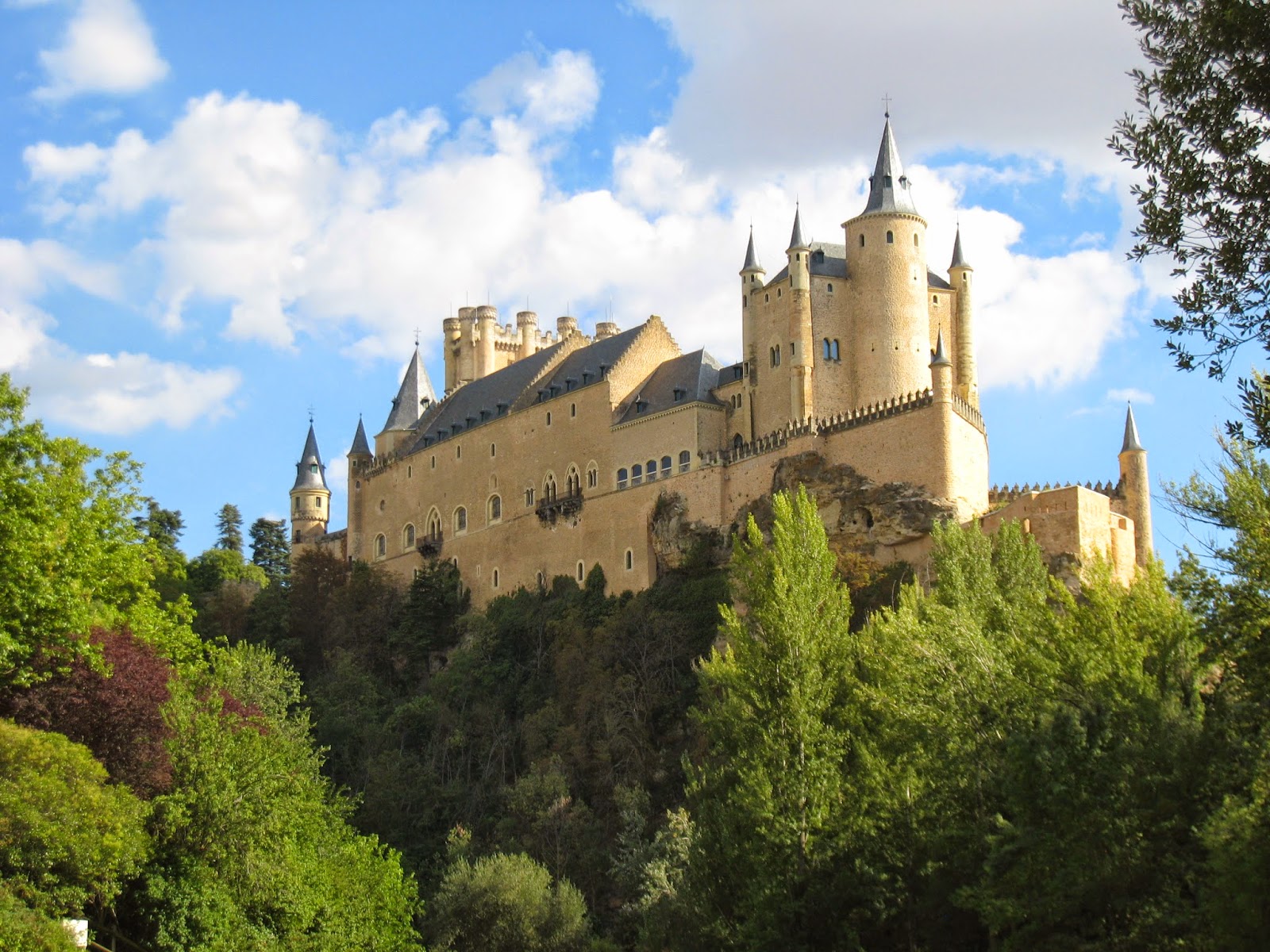
I left Malaga reluctantly, but was soon glad that I did.  If I hadn’t continued on my travels through Spain, I never would have discovered Segovia, which is my new favorite place in Spain.  I planned to stay for three days and ended up staying for five! Segovia, in the Castilla y Leon region northwest of Madrid is a world (ok, just a few hundred kilometers) away from Malaga.  The heart of life in Segovia still takes places in and directly around the old city walls.  A beautiful roman aqueduct, thousands of years old, runs right through the historic center. Beautiful old churches and monasteries abound.  The Alcazar (castle) is said to have been Walt Disney’s inspiration for the Beauty and the Beast castle. Beautiful green mountains are visible in the distance. All of this gives Segovia a sense of both magic and mystery. It’s a small city (pop. 50,000) so it’s very tranquil and surrounded by green spaces and two rivers.  Also, the people are really friendly!

In front of the aqueduct

When I arrived at my hostel, Blanca, who runs the hostel along with her friend Guillermo, gave me a map and pointed out all the highlights of the city.  She mentioned the location of a community garden and when I expressed interest in seeing it, she told me she and her friends have a plot, and I was welcome walk there with her if I wanted.  And so my time in Segovia began with a couple hours spent harvesting tomatoes and weeding garden beds in the most beautifully situated community garden I’ve ever seen, below the old city walls and irrigated by natural springs. Blanca pointed out to me an edible weed and asked if I knew it, and I realized it was purslane, which thanks to Martha in Silver City, I know is delicious.  Apparently I was the only one interested in eating it, so I created my own little purslane pile separate from the weeds.  Sauteed with onion and scrambled eggs, it made a great meal the following day! After gardening, I walked with Blanca and her friend Maria to a local bar en route to bring their veggies to the hostel, carrying a bag overflowing with tomatoes on one arm and a stalk of basil in my other hand. They told me I looked like a local and now I just needed to learn one phrase to sound like one too – “¿Que paja (paha), maja (maha)?”  Apparently Segovians says their “s” as a “j,” which in Spanish sounds like the English “h.” So this phrase is actually “¿Que pasa, maja?” to anyone outside of Segovia and basically translates to “how’s it going, friend?”  Armed with the magic words, I waived my basil wand and POOF, Rachel transformed to Raquel, from Segovia.

Segovia community garden (foreground) beneath the
old city walls.
Another day I took a long walk around the city, stopping every 20-30 minutes to pick blackberries from the abundant bushes.  If anyone every questions whether or not blackberries are an invasive plant, I invite you to visit Segovia, where blackberry branches climb up and over entire trees! When I left Germany I thought I had said goodbye to berries for the season, so although the Spanish berries are smaller and less juicy due to drought, this discovery was exciting. By the end of my afternoon-long stroll, I’d gathered enough blackberries to munch on for breakfast for the rest of the week. I also discovered on this walk, that the Alcazar is best enjoyed by circling the city.  I’d visited it the day before and been unimpressed by the interior and even the view from the front, but you just can’t beat this view from down below.

No, this is not a movie set backdrop - it really does
look this amazing.
Other highlights included a visit to a monastery, the massive palace gardens in a nearby town, a little museum about local cuisine, and a guided tour of a local photography exhibit in which I was the only non-native Spanish speaker, and I understood almost all of it! The old pre-Inquisition Jewish cemetery is somewhat preserved and the historic Jewish neighborhood still stands, although there’s little Jewish about it today other than the names of a few restaurants.  One restaurant, the Judería, serves Indian food tapas, and they’re actually not bad!  How’s that for cultural fusion? A tiny two-room museum about Sephardi Jews was unimpressive and not that informative unless you know nothing about Judaism, but I’m looking forward to my visit to the synagogue and museum in Toledo at the end of my trip. Magically, in a region known for its grilled meat, I found several vegetarian-friendly menus that also fit all my current dietary restrictions, despite the fact that the actual vegetarian restaurant in town was closed because the owners were on vacation. The aspect of Toledo I enjoyed the most was the people.  I had many nice conversations with Blanca and Guillermo and their friends, as well as shop and restaurant owners.  At the end of my time in Segovia, Blanca and Guillermo provided many suggestions for my travels in northern Spain and even printed out a map of the narrow gauge railroad line running across the northern coast.  They invited me to return for a longer stay and gave me my first night’s stay free for helping in the garden plot, which was a rather unexpected and nice surprise. I’ll definitely be returning there at the first opportunity I get.

Thursday, September 18, 2014

Malaga, My Spanish Home

Note: I'm a bit behind on posts - so I was actually in Malaga at the end of August/beginning of September

I travel from southern Germany to Malaga, Spain at the end of August, via a trip which took as long as it would have to fly from NY.  One tram, three trains, two flights, and two bus rides later, I arrive at the door of the apartment where I lived for several months in college, seven years ago.  And I am home, sort of.  My host mother, Esperanza, is awesome as always and I appreciate being able to reconnect with her.  Her apartment is just as I remembered it and as I enter she tells me “you know where your room is.”  It feels great to be speaking Spanish again, especially after a month in Germany, where communication was sometimes challenging. Certain sensory memories are very vivid, like the smell of the kitchen and the sweet intoxicating floral smell on the beautiful terrace, which I have always associated with summer in Malaga and which I finally learn is the smell of jasmine in bloom. Please note, that someday when I settle down into a stable home again, I’d like a jasmine plant as a housewarming gift.  And depending on where I live, maybe a greenhouse to keep it alive. Oddly though, the neighborhood is busier and a little dirtier than I remember, and there are far more shops and businesses on Esperanza’s street than I initially recall.  The plaza near the house is not what I remember, although I soon discover the plaza I picture in my head is just a bit farther down the road.  I think it’s likely that over the last seven years, I’ve changed more than the city has, and certainly the plaza didn’t move, just that my memories restructured over time.  It’s so strange that this happens!  Compared to New York City, Malaga is still clean and quiet and that was probably my main point of comparison at the time I lived there. As I walk around the neighborhood and the nearby downtown “El Centro” over the next week, I start to remember more streets, businesses and other sites, including the businesses on the street where I lived, and I can’t figure out if memories begin coming back to me as I take the time to notice each storefront and plaza or I just form new ones that overwrite the originals. Probably a little of both

Over the first few days, I spend most of my time hanging out with Esperanza, her parents and her sister’s family.  Her sister Cristi’s kids who were 3, 5, and 7 at the time I lived here are now teens and pre-teens, and I get to meet sweet Alejandra, born the year after I left.  We go to the beach and have big family meals, where I completely lose track of the multiple conversations taking place in rapid fire Spanish buried under thick Malagueño accents in which entire syllables are dropped from words. I receive cooking lessons from Esperanza once again and delight in preparing gazpacho, veggie paella and farinata (this last one is Italian, not Spanish).  It’s extremely hot and air conditioning is scarce. Because it’s so refreshing one day I actually drink Gazpacho with breakfast, lunch, and dinner!  I’m more hooked on Gazpacho now than I ever was when I lived here.

One other highlight for me was a visit to La Concepcion botanical garden which I never visited when I lived in Malaga.  Esperanza’s father Miguel is the president of the local “Friends of La Concepcion” association so I get my own personal guided tour and learn the history of the garden and all its secrets like the gazebo where your voice reverberates if you stand dead center and the curved bench where you can whisper back and forth with someone if you talk into the far corners.

Miguel, me, and Esperanza outside the La Concepcion garden.

Me, Esperanza (mother), Esperanza (daughter) in the garden.
A few days after I arrive, Esperanza leaves for a month-long trip to Budapest, to consult on the opening of a Spanish restaurant by a group of investors there.  I fall into a very slow-paced rhythm.  Sometimes I go to the Mercado Central for vegetables and I chat with the vendors in Spanish.  One night I go to a language exchange at a nearby bar where I practice my Spanish with locals and they practice their English with me.  I go to the beach almost every evening, once the crowds have left and the sun is less intense. It’s one of the only times of day in which I’m not unbearably hot and a dip in the Mediterranean completely revives me.  I’m excited that the city where I’ll be living in Israel is also coastal, as I’d forgotten how much I missed it after six years in a landlocked desert.  I visit Alcazaba, the fortress/palace built in the 9th century and rebuilt continuously thereafter, which plays a prominent role in both Malaga’s history and its landscape.  It’s visible from Esperanza’s terrace and I walk past it daily to get to the beach, so for me it is quintessential Malaga.  On the evenings I’m home, I practically live on the terrace where the air is cooler and the jasmine scent surrounds me.  I feel the need to mention here that for the people who actually live here, life is not a perpetual vacation – they have responsibilities just like the rest of the world.  And, crushing unemployment combined with the slashing of public services in an attempt to stem the bleeding of a poor economy have seriously reduced the quality of life for many Spaniards, a topic on which Esperanza gives me her perspective one night over dinner.  But for me, during my brief visit, life is pretty good in Malaga.

Street view of Alcazaba
Alcazaba
Alcazaba inner garden

As I start to plan the next leg of my trip, I realize I really don’t want to leave Malaga!  It’s familiar, relaxed, I have this wonderful apartment to myself with a kitchen, and a terrace, and my own bedroom, and the beach is within a twenty minute walk. On the other hand, I set out on this trip to see parts of Spain that I hadn’t visited seven years ago, and I’m pretty lazy in Malaga. Plus, my daily interactions seem to be decreasing the longer I stayed, which doesn’t exactly lend itself to practicing Spanish.  Still, I panic a little at the idea of leaving.  Fortunately, the next day I go to visit a great exhibit by a Spanish impressionist painter, Darío de Regoyos (side benefit – art museums have air conditioning!).  Regoyos was from País Vasco in north-central Spain and the northern landscape is the subject of many of his paintings.  They are beautiful and like nothing I’ve ever seen before in Spain.  This helps a little in convincing myself that unless I leave Malaga to travel around, I might never know the other Spanish towns that I will love.  So, still a bit ambivalent, I board a train to the north!
Street in Malaga city center (El Centro)